Technology Blog
Application of LoongShine panoramic video system in railway freight yard monitoring
Project requirements
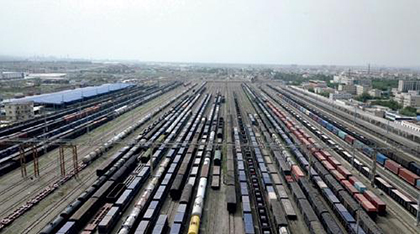
The railway freight yard is characterized by slenderness. In the monitoring of the freight yard, it is usually necessary to carry out full-area non-dead angle monitoring on the working surface of hundreds of meters long and tens of meters wide. The traditional scheme requires to erect a gantry every other distance or deploy monitoring cameras on nearby buildings to expect or obtain the best monitoring perspective. However, due to the problem of the field of view and angle of view of the surveillance camera, some blind spots may be created, which may give criminals an opportunity to take advantage of, thus causing unnecessary losses.

The use of video relay can significantly improve the problem of blind spots, but it also brings other problems:
- Infrastructure implementation issues: deploy more focal cameras at a fixed point; Or more fixed frames need to be built within a certain distance, which will increase the cost of management and operation and maintenance;
- The problem of monitoring large screen: It is necessary to broadcast the video of several adjacent cameras on multiple screens or in multiple windows on one monitor. Due to the superposition of the field of view, a moving target will appear on multiple screens or windows. At the same time, the brightness and color differences of different cameras will cause the monitoring picture to be messy, affecting the interpretation efficiency of the staff, and also not conducive to the leadership of video command decision-making;
In the traditional storage scheme, when the data center fails, the system has no remote disaster tolerance measures, resulting in the system monitoring stop; The monitoring data in the data center has no tamper-proof function, and is prone to malignant events of video evidence loss.
Panorama camera scheme
Intelligent panoramic imaging technology is to integrate multiple photoelectric imaging systems and cooperate with multi-channel electronic processing systems to achieve imaging of hundreds of millions or billions of pixels. This technology can solve the contradiction between the large field of view and high resolution of the traditional photoelectric system, and greatly improve the total amount of information transmitted by the photoelectric system. It integrates multiple focal length cameras in one device, which is easier to deploy, and the panoramic imaging camera supports solar DC power supply.

Through intelligent video splicing technology, 10 million to 1 billion pixels of video images can be output. It can achieve 30 fps real-time splicing at 10 million pixels and 5 fps real-time splicing at 500 million pixels. Through continuous optimization and upgrading of splicing algorithm and GPU hardware, this performance index is still improving.

Panoramic imaging cameras are spliced and fused with cameras of different focus segments to eliminate the monitoring blind area; Using the real-time fusion technology of seven groups of multi-focus camera video of 150 mm combination to obtain a smooth picture in the depth of 3~500 meters, the effective pixels are 80 million, the camera height is 6 meters, the horizontal inclination of the camera is 1.5 °, and the face recognition of 200 meters and the license plate recognition of 400 meters can be realized in the sunlight, which can greatly save the capital construction cost and management cost.

The virtual camera technology is used to provide external services. The virtual camera can be accessed through HTTP protocol, ONVIF protocol, RTSP protocol, GB-28181 standard and other methods, without changing the topology of the user's existing monitoring platform, and seamlessly access the existing monitoring platform based on the existing network; It supports H264 and H265 video coding formats and can seamlessly connect with third-party video structured systems and coding systems.

The splicing screen of each large monitoring screen corresponds to a virtual camera. The system will cut the splicing frame image into multiple independent virtual camera video frame images according to the number and resolution of the splicing screen, so that each splicing screen can display independently. If the splicing screen is thin, the display effect will be better.
LeoStor distributed storage solution
The panoramic camera needs low-latency NAS read and write, and LoongShine LeoStor scales the NAS storage system horizontally. It comes from high-performance computing, has advanced distributed storage architecture and parallel storage technology. The NAS read and write under the pressure of 10GB/s can still maintain millisecond latency, perfect data security and redundancy technology, support multiple copies and N+M: M erasure code, and WORM data tamper-proof security technology.

LeoStor supports S3 object storage. The panoramic imaging system can connect multiple data centers through the LeoStor S3 GTM. When a data center fails, the panoramic imaging system polls an available data center. At the same time, the data source of the monitoring system is also allocated to the data center to ensure that the whole monitoring process has a lower flash time of seconds.
The LeoStor distributed storage system can run on the 2U, 3U and 4U x86 storage servers of Great Wall, Wuzhou, Ultramicro, Huawei, Inspur, Dawn, Lenovo, DELL and HP, as well as the Great Wall, Lenovo's Feiteng ARM server and Huawei's Kunpeng ARM server.
Summary of system scheme
LoongShine panoramic video system includes six subsystems, providing a complete "delivery" system. The panoramic camera supports IP67 protection level, and the working temperature is - 40 ℃~80 ℃, meeting the deployment requirements of "field"; The splicing video can be cut in real time, which can be displayed through the virtual camera system and the large screen system. At the same time, the requirements of different resolutions can be met through the transcoding system.
LeoStor modular cabinets only need to be deployed in ordinary clean offices, without professional computer rooms. LeoStor high redundancy architecture, automatic fault recovery, strong self-sustainability, and significantly reduce the cost of operation and maintenance. At the same time, when a data center fails, through the scheduling of LeoStor GTM, it can automatically switch to the standby data center to meet the system-level disaster tolerance requirements of two places and three centers.